
 About Us
 Our Team
 Customer Reviews
 References
 Domestic tours
 International tours
 Individual tours
 Group tours
 Excursion
 Azərbaycan
 İngilis
 Rus
 Az
 En
 Ru
Gala & Ateshgah & Yanardag



Price: 17 AZN
-
 1
-
 Convenient Transportation
-
 In Azerbaijani
-
 Culture and History
Tour calculator
Guide
Car choose:
Sedan (1-3 seat)
Vito (1-7 seat)
Sprinter (1-16 seat)
All:
Price: 17 AZN
Back Submit your order
About tour
Gala State Historical Ethnographic Preserve
The Gala State Historical Ethnographic Reserve is a complex of museums in Baku, Azerbaijan. Inside there are three different types of museums. Vehicles are offered to visitors due to the spacious area of museums.
The museum is 1.5 ha in area and has rock paintings, pottery, household items, jewelry, weapons and coins belong to the ancient times of Azerbaijan. In this museum, there are more than 2,000 different archaeological and architectural monuments – mounds, seats of ancient settlements, burial places dating back to thousands of years ago.
There is an 18th-century tandoor, two underground passages belonging to the 10th and 15th centuries. Besides these, old houses, portable tents made of animal skins, stone and straw houses with domes, an old smithy, a pottery workshop, and a thresher can be found. All these can be touched and photographed.
Ateshgah
The Ateshgah of Baku often called the "Fire Temple of Baku", is a castle-like religious temple in Surakhany town, a suburb in Baku, Azerbaijan.
Based on Iranian and Indian inscriptions, the temple was used as a Hindu, Sikh, and Zoroastrian place of worship.The pentagonal complex, which has a courtyard surrounded by cells for monks and a tetrapillar-altar in the middle, was built during the 17th and 18th centuries. It was abandoned in the late 19th century, probably due to the dwindling of the Indian population in the area.
The Baku Ateshgah was a pilgrimage and philosophical centre of Zoroastrians from Northwestern Indian subcontinent, who were involved in trade with the Caspian area via the famous "Grand Trunk Road". The four holy elements of their belief were: ateshi (fire), badi (air), abi (water), and heki (earth). The complex was turned into a museum in 1975.
Yanar Dagh
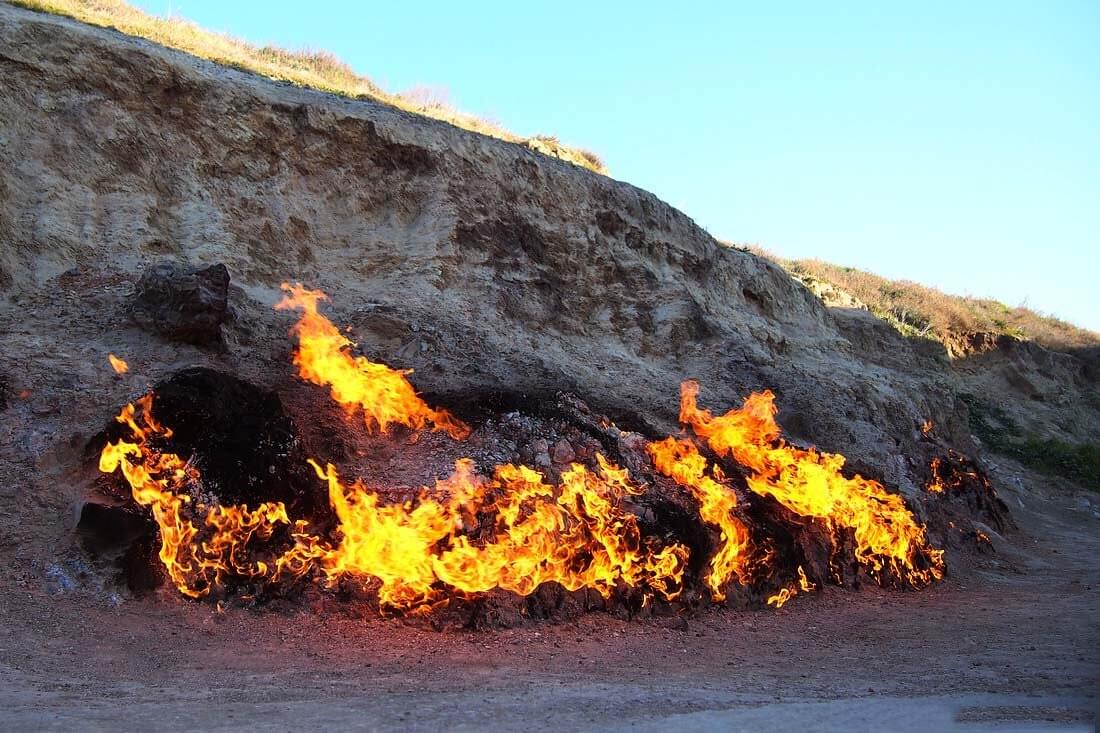
Yanar Dagh is a natural gas fire which blazes continuously on a hillside on the Absheron Peninsula on the Caspian Sea near Baku, the capital of Azerbaijan.
In the first millennium BCE, the fire played a role in the Zoroastrian religion, as the link between humans and the supernatural spheres.
The Yanar Dagh fire is never extinguished.
Alexandre Dumas, during one of his visits to the area, described a similar fire he saw in the region inside one of the Zoroastrian fire temples built around it. Only a handful of fire mountains exist today in the world, and most are located in Azerbaijan. Due to the large concentration of natural gas under the Absheron Peninsula, natural flames burned there throughout antiquity and were reported on by historical writers such as Marco Polo.
Balakhani
Balaxanı or Balakhani (Tat: Balaxana) is a settlement and municipality near Baku, Azerbaijan, on the Absheron Peninsula. Taking advantage of the area's oil pools, a 35 m deep well was dug manually in 1593. The Russians built the first oil-distilling factory here in 1837.